Your system already works. It should also be usable.
You paid for a Q-SYS or installed AVL system that does the job on paper and fights the operator in the room. We don't rip it out or resell you the install. We read what's there, fix what's wrong, and hand it back cleaner than the integrator left it.
Start with a system-health audit.
One engineer, one day on your system. Cores, DSP, routing, the operator interface, and the parts of the signal chain everyone's afraid to touch.
No sales visit dressed as a diagnostic. You get a real read on what you own and what it's costing you.
Half-day audit at $1,500. Full day at $2,500 when the system is large or the room is live.
Credits in full toward any work you book within 30 days. The diagnosis is never money you lose.
Where the system stands, what's costing you, and what to fix first — on paper, so you can act on it without us in the room.
A fixed fee per problem. No clock.
Every fix after the audit is quoted as a fixed fee against a named problem, agreed before we start. You know the number before we touch the core.
No timers, no surprise line at the end of the month. The fee is the fix, not the hours it took us.
What we touch
- Q-SYS cores, DSP, and Q-LAN / Dante / AES67 routing
- Operator interfaces (UCI) rebuilt around how the room is actually run
- Gain structure, presets, and automation that drift over time
- Ease-of-use rework: fewer buttons, in the right order, in plain language
- Documentation the next tech can pick up cold
What we don't
- New installs or ground-up system design
- Ripping out working hardware to sell you ours
- Pulling cable or rigging — that goes to your install partner
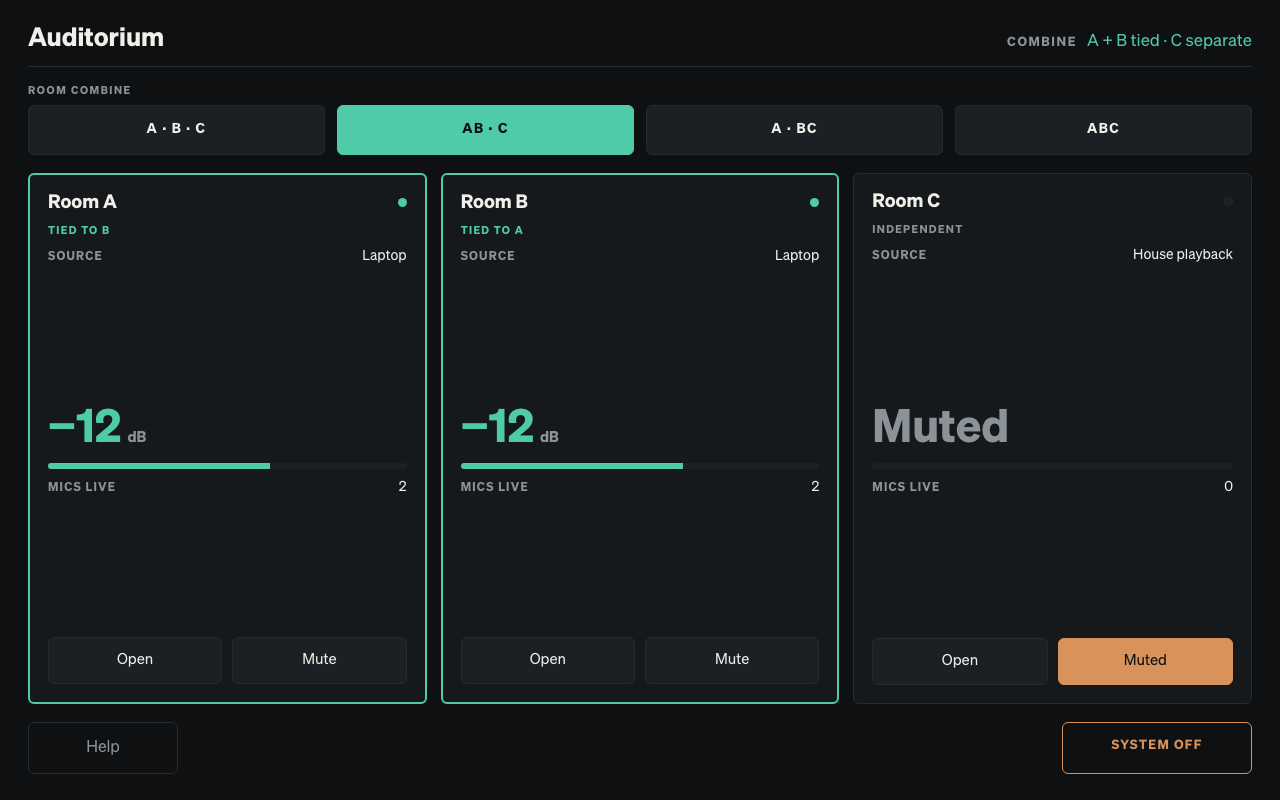
The panel is the deliverable.
An auditorium that splits into three rooms on two walls. Two walls make four combine states, so the panel offers four. The pairing that can't physically happen isn't on the screen. Someone who has never run the room should be able to walk up and use it.